Coating a façade in cold, wet or dewy weather: data sheet and VOB
Jump through this article
On the data sheet, a façade coating has a clean processing range; on the wall, it has weather. The decisive factor is rarely the air temperature at midday. What counts is the state of the surface during the hours in which the fresh layer has not yet dried through – and that is often decided at night.
What the façade does at night
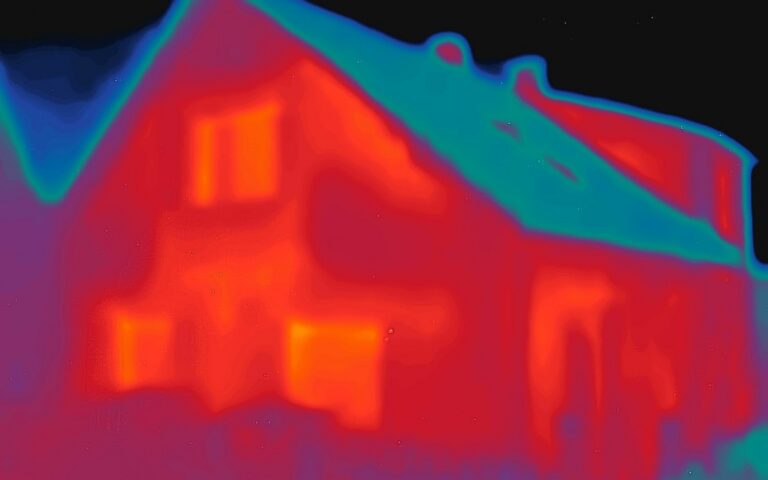
Insulated façades cool down. Baunetz Wissen describes it for external thermal insulation composite systems as follows: they thermally shield the solid building elements, have no storage mass of their own and therefore cool at night through radiation to below the air temperature; condensation forms on them. The Fraunhofer IBP (Fraunhofer Institute for Building Physics) describes the same mechanism in IBP-Mitteilung 438 (2004): if the surface temperature falls below the dew point temperature of the outside air, the wall is wetted by condensation.
On two west-facing façades, the dew point temperature was undershot for considerably longer on a wall with an external thermal insulation composite system than on a monolithic construction. The IBP names autumn and spring as critical periods for biological infestation of external walls. For scheduling this is a conclusion, not a standard value: anyone coating in the transitional months is better advised to base the application on the measured trend of the surface temperature than on the weather forecast.
Dew point: the calculation behind the dew
According to Baunetz Wissen, the dew point temperature is the temperature at which relative humidity reaches 100%. If the air temperature falls further with the moisture content unchanged, condensation forms. A worked example from the same specialist portal: at an air temperature of 20 °C and 50% relative humidity, the moisture in the air condenses on every surface colder than 9.3 °C.
Air temperature, surface temperature and relative humidity must therefore be measured together, ideally at the coldest and most heavily shaded point of the façade. A single value such as “it is ten degrees” says little about dew, wetness and drying.
What the data sheet specifies
The limits for temperature, humidity and waiting times are set by the manufacturer of the coating system, not by a general rule of thumb. The table shows which quantities should be read from the data sheet or system manual before work starts and how they are checked on site.
| Quantity | Question for the data sheet | Check on site |
|---|---|---|
| Air temperature | Lower and upper limit during application and during drying | Thermometer in the shade, several times during the day |
| Substrate temperature | Minimum and maximum value at the surface | Surface thermometer, north and south sides separately |
| Relative humidity | Upper limit during application | Hygrometer on the scaffold |
| Distance from the dew point | Is a minimum distance required? | Determine the dew point from air temperature and humidity, compare with the surface temperature |
| Rain and dew after application | From when can the layer withstand loading? | Weather forecast, schedule of coats, protection by scaffold sheeting |
| Waiting time between coats | Dependence on temperature and humidity | Note time and conditions for each coat |
What such a specification can look like: the technical information sheet for the PScoat coating, which the operator of this site sells, gives as the supplier’s statement for air and substrate 5 to 30 °C at below 80% relative humidity, with the addition that colder or more humid conditions lengthen every time. This applies to this one system. It cannot be transferred to other products; how to read data sheets is explained in the article Reading the data sheet: V and W classes.
What VOB/B and VOB/C make of it
Whether the VOB applies is decided by the contract. According to the IHK Südlicher Oberrhein (Chamber of Industry and Commerce; as at March 2023), the VOB/B (German General Contract Conditions for Construction Works) is not a statutory standard that applies independently of the will of the contracting parties, but becomes part of the contract only if the parties agree it. Under § 1(1) VOB/B, the General Technical Contract Conditions (VOB/C) then also form part of the contract.
For façade coatings these are above all ATV DIN 18363 “Maler- und Lackierarbeiten – Beschichtungen” (painting and varnishing work – coatings) and, for plastering work, ATV DIN 18350 “Putz- und Stuckarbeiten” (plastering and stucco work). DIN lists DIN 18363 in the 2019-09 edition as current; it applies to coating with varnishes, paints and other coating materials and contains a section “3 Ausführung” (execution).
According to DIN, the VOB/C represents the specified minimum standard, unless the contract makes more extensive performance agreements. The standards texts are subject to a fee; anyone who wants to cite weather limits from the ATV needs the wording of the version agreed in the contract. Rules of thumb do not replace it.
From the VOB/B (2016 version, published by the Federal Ministry of Building), four provisions matter for the weather:
- § 4(2) no. 1: The contractor carries out the work on its own responsibility and must observe the generally recognised rules of technology.
- § 6(2) no. 2: Weather influences that normally had to be expected when the bid was submitted do not count as a hindrance. Normal weather therefore does not justify an extension of time.
- § 6(1) and (4): If the contractor believes itself to be hindered, it must give written notice without delay. An extension of time is calculated with a surcharge, among other things for the shift into a less favourable season.
- § 4(5): Until acceptance, the contractor protects its work against damage; at the client’s request also against winter damage and groundwater.
Notify concerns in writing
§ 4(3) VOB/B requires concerns about the intended method of execution to be notified in writing without delay, if possible before work begins. Anyone who is pushed towards a date at which the data sheet window will not be reached has their instrument here. Whether a scheduling instruction falls under “method of execution” depends on the individual case.
The consequence is regulated by § 13(3): if a defect is attributable to instructions from the client, the contractor is nevertheless liable unless it has given the notice under § 4(3). On how to structure a notification of concerns about the substrate, see Checking the substrate under VOB and BFS.
Procedure on site
- Before starting, read off the data sheet window: air, substrate, relative humidity, waiting times.
- Measure at the start of work and at fixed intervals: air temperature, surface temperature, relative humidity, and from them the dew point.
- Coat only while the values are within the window and the surface stays above the dew point; schedule the coats towards the evening and the night.
- In case of deviations, interrupt work and give written notice of the hindrance (§ 6(1)) or concerns (§ 4(3)).
- Record the values with date, time, façade elevation and measuring instrument.
Where the VOB/B has been agreed, the weather risk normally lies with the contractor. What protects it is less the weather portal than a measurement record and timely written notice.
Sources
- VOB/B – Allgemeine Vertragsbedingungen für die Ausführung von Bauleistungen (General Contract Conditions for the Execution of Construction Works) (BMWSB) – 2016 version, published in the Bundesanzeiger (BAnz AT 19.01.2016 B3, BAnz AT 01.04.2016 B1)
- IBP-Mitteilung 438: Einfluss der Außenwandkonstruktion auf nächtliche Betauung und mikrobiellen Bewuchs (influence of the external wall construction on nocturnal dew formation and microbial growth) (Fraunhofer IBP) – IBP-Mitteilung 438, 31 (2004)
- Grauschleier an Fassaden (grey haze on façades; Baunetz Wissen) – accessed 30 October 2026
- Taupunkttemperatur (dew point temperature; Baunetz Wissen, glossary) – accessed 30 October 2026
- Feuchteschutz: Kondensatausfall (moisture protection: condensation; Baunetz Wissen) – accessed 30 October 2026
- Werkvertragsrecht (law of contracts for work) (IHK Südlicher Oberrhein) – as at March 2023
- Vergabe- und Vertragsordnung für Bauleistungen (VOB) (German construction procurement and contract rules) (DIN e. V.) – accessed 30 October 2026
- VOB Teil C: Inhaltsverzeichnis der ATV (VOB Part C: table of contents of the ATV), VOB 2019 complete edition (VOB online / DIN Media) – VOB 2019 complete edition
- DIN 18363 – ATV Maler- und Lackierarbeiten, Beschichtungen (painting and varnishing work, coatings) (DIN e. V.) – 2019-09 edition, status current (accessed 30 October 2026)
- DIN 18363:2019-09 – Inhaltsübersicht (table of contents) (DIN e. V.) – 2019-09 edition
- Technisches Merkblatt PScoat (technical information sheet; supplier’s statement, powersmartcoat.de) – accessed 30 October 2026; supplier’s statement by the operator